
The four hidden water leaks signs worth acting on are a meter that moves with every tap closed, a musty smell with no visible water, warm patches underfoot, and a bill that climbs while the household stays the same. Any one of them means water is running somewhere you cannot see it.
The EPA puts the average household loss from leaks at close to 10,000 gallons a year. The water is the cheap part. What costs money is what the water is doing to framing, plaster, and flooring in the months before anyone notices. A plumber in Huntington, NY, can usually confirm or rule out a hidden leak in a single visit, and our water leak detection and repair work begins with that confirmation rather than with a guess.
The meter test that settles it in twenty minutes
Close every fixture in the house, including anything on a timer, such as an ice maker or an irrigation zone. Take a reading at the meter, wait twenty minutes without touching a tap, then read it again.
If the number moved, water left the system. The EPA notes that around ten percent of homes lose ninety gallons a day or more to leaks, so a moving meter is common rather than exotic. What the test cannot tell you is where, which is the part we handle.
Musty smells with no visible water
Damp concentrates behind finishes long before it shows on them. A cupboard, a corner of a basement, or one end of a hallway that smells different from the rest of the house is worth taking seriously, particularly when the smell is stronger in the morning.
Smell reliably precedes stain, and it is often the only warning a slow supply leak gives for months. If the source is a joint inside a wall, nothing will appear on the surface until the material behind it is already saturated.
A dehumidifier that fills in one room while the rest of the house stays dry points the same way, and it usually shows up well before any smell does.
Warm patches underfoot and running sounds at night
A warm area on a floor that has no heating under it usually means a hot supply line is leaking below the slab. It is one of the few leak signs that points almost directly at the location, which makes it the cheapest of them to act on.
The other test costs nothing. Stand still in a quiet house with everything switched off and listen for running water. Water damage claims are among the most frequent and most costly in residential insurance, as industry claim data shows, and a slab leak found by ear on a Sunday is a great deal cheaper than one found by a contractor.
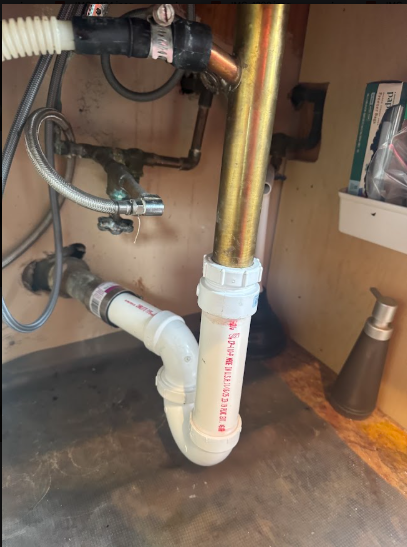
A tank-style water heater that is weeping at the base
Moisture around the base of a tank-style storage water heater is different from the other signs on this list, because it is rarely repairable. A weeping tank means the inner lining has gone, and no fitting or valve replacement brings that back.
We will always check the fittings, the relief valve, and the connections first, since a leak at any of those genuinely is a repair. Where the tank itself has failed, water heater repair in Huntington, NY, becomes a replacement conversation instead, and we would rather install a new tank-style unit on a planned day than pump out a basement on an unplanned one. A storage tank keeps hot water available all year with no delay at the fixtures, low maintenance, and far less expense from breakdowns.
Paint, plaster, and the slow structural cost
Sustained moisture does not announce itself. Paint lifts slightly, plaster softens, and each of those reads as an aging house rather than an active leak. The framing behind them absorbs water for as long as the supply keeps running.
That is where a plumbing bill turns into a carpentry bill. The water efficiency data published by the EPA covers the volumes involved, but the structural repair is what people remember. Finding a leak in week two is a fitting. Finding it in month eight is a wall.
Finding it before the drywall does
Every sign on this list is cheap to investigate and expensive to ignore, and the gap between those two grows every week. If the meter moves, call someone. We are the emergency plumber in Huntington, NY, people reach when the sign has already become a stain.
J&B is a family owned company working across Suffolk and Nassau on leak detection, pipe repair and tank-style water heaters, and a hidden leak from a compromised drain sometimes turns out to need sewer line repair in Huntington, NY, rather than supply work. Request a leak detection visit and find it while it is still small.
Frequently Asked Questions
How can a leak be found without opening walls?
Acoustic listening equipment, pressure testing of isolated sections and thermal comparison all narrow the location before anything is opened. In most cases we can identify the affected run and open a single access point rather than a wall.
What does a leaking water heater base usually mean?
Moisture at the base of a tank-style unit normally indicates the inner tank has corroded through, which is not repairable. Leaks at the fittings, connections or relief valve are a different matter and can often be fixed.
How quickly does hidden moisture damage framing?
Timber begins to absorb moisture immediately, but structural consequences build over months. Repeated wetting and drying is more damaging than a single soaking, which is why intermittent leaks often cause the worst outcomes.