
If you are dealing with a burst pipe and don’t know what to do while water is still running, the order is this. Shut the main off, cut power to the affected area, open the lowest taps in the house, then call. Those four steps take under ten minutes and they decide most of what the repair ends up costing.
Everything after that is our problem rather than yours. The gap between a contained burst and a flooded story is almost always how quickly the main was closed, not how fast anyone drove. Reach an emergency plumber in Massapequa, NY, while you are working through the steps rather than once you have finished them. Our emergency plumbing line is answered around the clock, seven days a week.
Minute one: shut the water off at the main
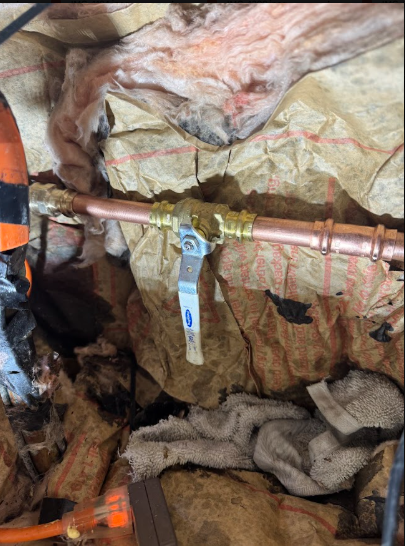
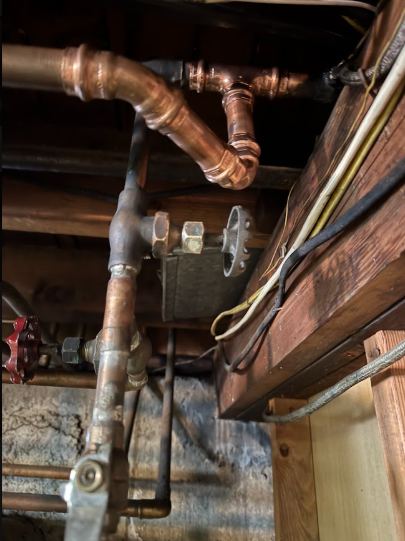
The main valve usually sits where the service enters the building, on the street side of the meter, most often in a basement or utility space. Turn it clockwise until it stops moving. On older Long Island housing stock it may be a gate valve with a round handle rather than a lever.
Ready.gov keeps a short guide to locating and operating household shut-offs, and it is worth reading on a quiet evening rather than in an emergency. If the valve turns freely but water keeps running, the gate has failed internally and the curb stop outside is the next option.
Minute two: cut power to the affected area
Standing water and live circuits do not mix. If water is anywhere near an outlet, a panel or a running appliance, pull the breaker for that area before you step into the room.
Water conducts, and a basement with two inches standing on the floor turns every low outlet into a hazard. If you can reach the board from dry ground and cannot tell which breaker serves the room, switch the main off instead of guessing. If the panel itself sits inside the wet zone, do not approach it at all. Stay out, wait for us, and tell the technician what you saw and where. No amount of saved carpet justifies walking into that room, and we have never once wished a customer had taken the risk.
Minutes three to five: drain the system and contain the water
With the main closed, open the lowest faucets in the house and flush a toilet. That drops the pressure in the line and pulls the water still sitting in the pipes down and out through the fixtures rather than through the break.
Ready.gov guidance on responding to flooding indoors applies here as well. Move what you can lift, get anything absorbent off the floor, and leave contents where they are if water is still rising in that room.
Minutes five to ten: document everything for your insurer
Photograph the break, the water and every room it reached, with the timestamps left intact. Insurers assess water damage partly on how quickly it was contained, and the Insurance Information Institute publishes claim data showing how quickly these losses grow once water spreads beyond one room.
Keep any section of failed pipe we remove. It is physical evidence of cause, and cause is usually what decides whether a claim is paid or argued over. We will bag it and label it for you if you ask.
What we do when we arrive
The first job is isolating the failed section so the rest of the house can go back into service. We cut out the damaged run, check the pipe either side of it for the same fault, and pressure test before anything is closed up again.
Where a plumber in Massapequa, NY, finds general corrosion rather than a single failure point, we will say so plainly. A patched section on a run that is failing along its length will not hold for long, and you deserve to make that call with the facts in front of you.
Once the water is back on we check the fixtures downstream as well, because debris from a failed section travels and lodges in aerators and cartridges. It is a small step that saves a second call-out a fortnight later, and it takes us about five minutes while the tools are already out.
Ten minutes that decide the repair bill
A burst pipe is not a repair you can take on yourself, but the first ten minutes belong entirely to you and they matter more than anything that follows. We keep a 24-hour plumber in Long Island available seven days a week for this exact call.
J&B has spent over a decade on burst lines, pipe replacement and emergency work across Suffolk and Nassau, and we would far rather talk you through the shut-off on the phone than arrive to a flooded floor. Whether you need an emergency plumber in Long Island tonight or a pipe replacement quote tomorrow, call now, 24 hours a day.
Frequently Asked Questions
Where is the main water shut-off valve usually located?
In most Long Island homes it sits where the water service enters the building, on the street side of the meter, commonly in a basement, crawl space or utility room. Older properties may have a gate valve with a round handle rather than a quarter-turn lever.
Should the power be turned off before or after the water?
Shut the water first, then cut power to the affected area before entering it. If the electrical panel itself is near standing water, do not approach it and wait for a technician.
Does homeowners insurance cover a burst pipe?
Coverage varies by policy and by cause. Sudden accidental discharge is commonly covered while gradual seepage often is not, so photographs, timestamps and the failed section of pipe all help establish what happened.